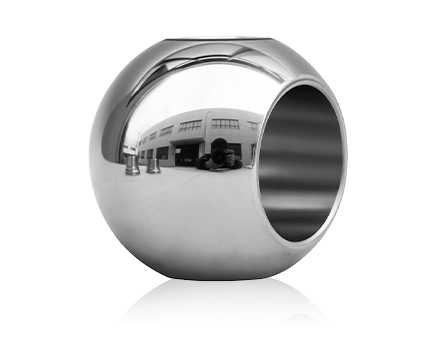
A stainless steel hollow ball can look simple once it has been formed, but keeping its shape consistent through production requires attention at several stages. Roundness is not determined by one operation alone. The condition of the material, forming process, section alignment, joining method, and later finishing can all influence the final shape.
For Stainless Steel Hollow Ball Manufacturers, controlling roundness starts before the finished ball takes its final form. Small changes during forming may become more noticeable when separate sections are assembled or when heat is introduced during joining. Surface treatment can also affect the appearance of an otherwise well-formed part.
The practical approach is therefore to treat shape control as a continuous process rather than a final inspection step. Each stage has a role, and the result from one stage can affect the work that follows.

What Causes Roundness Variations in Stainless Steel Hollow Balls
Roundness variations can begin during forming and continue through later operations. A sheet or formed section may not take the intended shape evenly, particularly when pressure is not distributed consistently across the material. Once that section is joined to another part, an early shape difference can become harder to correct.
Several factors can influence the finished geometry:
- Uneven forming can create local changes in curvature.
- Material condition can affect how readily a section takes its intended shape.
- Incorrect positioning can leave sections slightly offset before joining.
- Heat from joining can cause local movement or shape change.
- Finishing operations may alter an edge or joint if excessive force is applied.
This is why Stainless Steel Hollow Ball Manufacturers generally need to consider roundness throughout production rather than treating it as a final-stage concern.
Another point is that a hollow structure does not behave in exactly the same way as a solid piece. The internal space means the outer shell depends heavily on its formed geometry. Once a local area moves out of position, restoring the intended curve may require additional work.
The shape should therefore be considered at the material, section, assembly, and finished-product stages.
How Does Forming Affect the Roundness of Hollow Balls
Forming is where the flat material begins to acquire the curved shape required for a hollow ball. The way the material is pressed, shaped, or otherwise formed can influence how evenly the curve develops.
A section that appears acceptable at one point in production may still have slight differences across its surface. These differences can become more noticeable when the section is placed against another part.
Consistent forming depends on maintaining a stable relationship between the material and the forming equipment. If the material moves differently from one area to another, the resulting curvature may vary.
The forming stage also needs to account for the fact that metal can retain some tendency to move after pressure is removed. A formed section may change slightly as it leaves the tooling. That makes it useful to consider the shape after forming rather than relying only on the appearance while the material is still held in place.
For Stainless Steel Hollow Ball Manufacturers, checking formed sections before further assembly can prevent a small deviation from being carried into later stages. If a section already has an obvious shape difference, joining it to another section will not necessarily remove that difference.
A controlled forming sequence can therefore reduce the amount of correction required later.
How Does Material Thickness Affect Hollow Ball Shape
Material thickness has a direct relationship with how a hollow ball section behaves during forming and later processing. Thinner material can respond differently to forming pressure and handling, while thicker material may require different forming conditions to achieve the intended curvature.
The important point is not simply whether a material is thick or thin. The consistency of the material across the area being formed also matters. Variations can make one portion respond differently from another, creating changes in curvature.
Material thickness can also influence joining. When separate sections meet, differences in their edges may make alignment more difficult. The resulting joint can then require additional adjustment before the parts are joined.
A useful production check is to consider three related questions:
| Production stage |
Shape-related consideration |
| Before forming |
Is the material condition consistent across the section |
| During forming |
Does the section develop an even curve |
| Before joining |
Do adjoining edges maintain a suitable relationship |
| After joining |
Has the original shape remained stable |
Material handling matters as well. A formed section can be affected by unnecessary pressure during movement or storage. For that reason, maintaining its shape between operations is part of controlling the final result.
Stainless Steel Hollow Ball Manufacturers working with different material conditions may therefore need to adjust the forming approach rather than treating every production run in exactly the same way.
How Do Manufacturers Align Sections Before Joining
Not every hollow ball is made from the same number or arrangement of formed sections. Where separate sections are used, however, their alignment becomes an important part of maintaining the intended spherical shape.
Before joining, the sections need to sit in the correct relationship to one another. If one section is shifted, tilted, or rotated incorrectly, the completed ball may show an uneven curve even when each individual section looked acceptable on its own.
Alignment also affects the joint itself. Edges that meet unevenly can require additional correction before joining. Trying to compensate for a poor fit during the joining operation can introduce further movement.
A practical sequence involves:
- checking the formed sections before assembly;
- placing adjoining edges in the intended position;
- keeping the sections stable during positioning;
- checking the overall shape before permanent joining.
This stage is particularly important because it creates the starting condition for the next operation. Once the sections are permanently connected, correcting a positioning problem can become more difficult.
For Stainless Steel Hollow Ball Manufacturers, alignment is therefore not simply an assembly task. It is part of geometric control.
How Can Welding Affect the Roundness of Hollow Balls
Welding can affect the shape of a hollow ball when heat is concentrated around a joint. The heated area can move as the material responds to the temperature change, and the surrounding metal may respond differently.
The effect depends on the construction and joining method used. A ball with welded sections has a joint that requires careful control because the connection is formed while the surrounding material is being exposed to heat.
The relationship between welding and roundness can be viewed in three stages:
| Welding stage |
Potential effect on shape |
| Before welding |
Poor alignment can create an uneven starting condition |
| During welding |
Local heating can cause movement near the joint |
| After welding |
The cooled joint may retain a changed shape |
This does not mean that welding will automatically produce a visible distortion. The result depends on how the parts were positioned, how the joining operation was carried out, and how the structure was supported.
The key consideration is to prevent unnecessary movement while the joint is being formed. A stable setup gives the sections a better chance of retaining their intended relationship as the work progresses.
Where welded construction is used, Stainless Steel Hollow Ball Manufacturers need to consider welding as part of overall shape control rather than as an isolated joining operation.
How Can Fixtures Help Maintain Hollow Ball Shape
Fixtures can help hold formed sections in position while production work is taking place. Their role is relatively straightforward: reduce unwanted movement and maintain the intended relationship between parts.
This becomes particularly useful when the shape is curved. A spherical section does not always provide an easy flat surface for positioning, so uncontrolled movement can make alignment more difficult.
A suitable fixture arrangement can help with several tasks:
- keeping sections in the intended position;
- maintaining alignment during joining;
- reducing movement during handling;
- supporting the work while heat is introduced;
- making repeated positioning more consistent.
Fixtures should not be viewed as a substitute for accurate forming. If the sections are poorly shaped before they reach the fixture, holding them in place does not necessarily solve the underlying problem.
Their value comes from maintaining a suitable starting position throughout the operation.
For Stainless Steel Hollow Ball Manufacturers, fixture design may therefore vary according to the shape and construction of the ball being produced. The objective remains the same: keep the work stable enough that later operations do not introduce unnecessary shape changes.
How Are Shape Deviations Corrected After Forming or Joining
Some shape deviations become visible only after forming or joining is complete. At that point, the appropriate response depends on where the deviation occurred and how significant the correction needs to be.
The first step is to identify whether the issue comes from the formed section, the assembly relationship, the joint, or later handling. Treating every deviation in the same way can create additional distortion.
Correction may involve controlled reshaping or adjustment of the affected area. The process needs to avoid creating a new irregularity elsewhere on the ball.
For joined structures, particular attention may be needed around the connection because local deformation can affect the surrounding curve. A correction that focuses only on the visible area may not restore the overall shape.
It is also useful to distinguish between a surface imperfection and an actual geometric deviation. A mark or uneven finish may change the appearance without substantially changing the ball's form. Conversely, a smooth-looking surface can still have a shape problem.
This distinction helps Stainless Steel Hollow Ball Manufacturers determine whether the next operation should focus on forming, adjustment, or surface treatment.
How Is Roundness Checked on Finished Hollow Balls
Final inspection provides a way to confirm whether the completed hollow ball has retained its intended shape. The check should consider the whole surface rather than relying on one visible area.
A finished ball can appear round from one viewing angle while showing a deviation from another. For that reason, inspection should consider different positions around the part.
The inspection process may consider:
- overall spherical appearance;
- consistency of the curved surface;
- alignment around joined areas;
- local deformation;
- the condition of the finished surface.
Inspection results can also provide useful information for production control. If similar shape deviations repeatedly appear in the same stage, the cause may be further upstream.
For example, repeated changes near a joint may point toward alignment or joining conditions, while a broader shape difference may indicate an issue during forming or handling.
This makes final inspection more than a simple pass-or-fail activity. It can also help connect the finished condition with the manufacturing stage that produced it.
For Stainless Steel Hollow Ball Manufacturers, maintaining roundness is therefore a sequence of related decisions. Forming establishes the basic geometry, material consistency supports predictable shaping, alignment prepares sections for joining, and fixtures help maintain their position. Where welding is used, heat and movement require additional attention. Later correction and inspection then provide opportunities to address deviations before the finished hollow ball moves to its intended application.

 English
 中文简体
中文简体
 русский
 Español
 عربى
عربى
 italiano